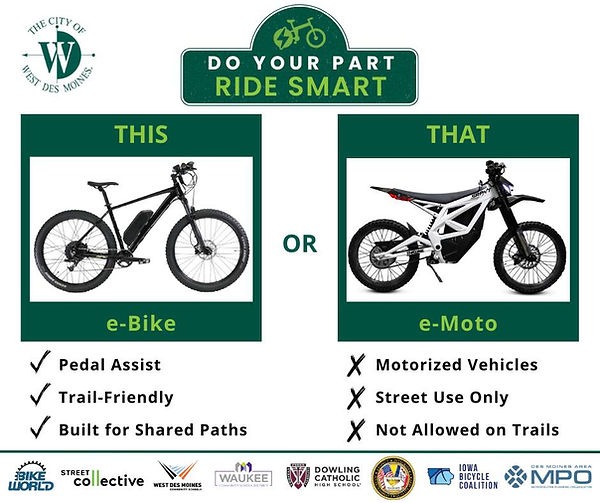
This week I’d like to share some perspectives from the other side of the river at bikeiowa.com, and from Street Collective in Des Moines. All locales seem to be grappling with the same issues these days. How do we promote legal use of e-bikes while discouraging e-motos? Sure, they’re capable of riding under 20 mph on trails, but is that what we often see them doing? Rather than trying to er, re-invent the wheel, I’m posting what bikeiowa has to say on the subject:
Posted by David Krohse to Facebook on Mar 14th 2026
BIKEIOWA NOTE: This is a great real-world on-the-ground commentary!
Per David “This is a fantastic take, although I’m a fan of ‘coming by’ instead of ‘on your left'”
Written by: Glenn Rieker (source where posted is unknown)
The Great E-Bike Panic of the 21st Century is one of those mysteries that will someday confuse historians. Right up there with powdered wigs and New Coke. Apparently, a device that helps people ride bicycles is now considered controversial. Meanwhile, the rest of us are just out there pedaling along, wondering how we ended up in a culture war over handlebars.
Here’s what actually happens in the real world. A lot of people who haven’t been on a bike since they were ten years old suddenly realize they can ride again. Their knees don’t hate them. The hills aren’t terrifying. And before you know it, they’re smiling like kids who just rediscovered recess. That’s not a public safety crisis. That’s a small miracle with handlebars.
Then there’s the other group—those of us who have been riding for decades. The e-bike doesn’t replace riding; it multiplies it. Suddenly that 12-mile ride becomes 25. The “maybe tomorrow” ride becomes “let’s go now.” Trails get used more often, people stay active longer, and everyone’s doctor quietly nods in approval.
And here’s a little economic plot twist: cyclists tend to eat. A lot. Which means e-bikes also power something else—the local economy. Riders stop for coffee, sandwiches, ice cream, pie, beer, pastries, and occasionally something resembling a healthy meal. Bike shops sell gear, restaurants fill tables, and little trail towns stay alive because cyclists keep rolling through. If you want to boost small-town business, forget tax incentives—just build a good bike trail and let hungry cyclists loose.
E-bikes also do something else pretty remarkable. They build community. Group rides get bigger and more diverse. Friends of different fitness levels can ride together. Couples stay together instead of one rider waiting three miles ahead at the next trail bench pretending to admire the scenery. Everyone moves at roughly the same pace, which turns rides into conversations instead of endurance tests.
Now let’s talk about the big scary issue everyone loves to debate: speed.
I ride between 13 and 18 miles an hour on my recumbent trike or fat tire bike. As I approach walkers or riders, I do this radical thing called basic courtesy. I say, “On your left.” People move slightly, nobody panics, and civilization continues.
But occasionally you’ll see a middle-aged gentleman in head-to-toe spandex—let’s call him Captain Tour de Subdivision—flying down the trail at 25 miles an hour like he’s chasing a podium finish in the Tour de France. No announcement. No bell. Just a blur of Lycra and a small child wondering what that whooshing noise was.
Then there’s the walker with earbuds in, whose phone proudly dings to announce they’ve reached the halfway point of their walk. Without so much as a glance over the shoulder, they execute a perfect U-turn directly into the path of an approaching cyclist. It’s like watching wildlife documentaries where the gazelle suddenly darts into the lion’s mouth.
And we can’t forget the retractable dog leash—the engineering marvel that allows a dog to create an invisible tripwire across the entire trail. Or the off-leash dog that decides cyclists are clearly part of an exciting chase game invented specifically for them.
Yet somehow… the e-bike is the villain in this story.
Sure, there are a few ridiculous machines out there with way too much power and pedals that exist mostly for legal decoration. Those are closer to motorcycles wearing Halloween costumes. But regulating every normal e-bike because of a handful of those is like banning pickup trucks because someone installed a monster engine in their lawn mower.
Think about it this way: we allow people to own Porsches and Lamborghinis capable of going 150+ miles per hour. They’re still allowed to drive them on public roads. The rule is simple—if you speed, you get a ticket.
And last time I checked, there isn’t a dedicated Bike Trail Police Department patrolling the Interurban Trail with radar guns and flashing lights. Society has bigger problems to solve.
Most people on trails—whether walking, biking, or e-biking—are simply trying to enjoy the outdoors, get some exercise, and maybe justify the ice cream stop five miles ahead.
So instead of turning e-bikes into the villain of the cycling world, maybe we focus on something simpler: trail etiquette, common sense, and basic courtesy.
Because the real secret to safe trails isn’t the type of bike you ride.
It’s whether you remember to say, “On your left.”
Also, there’s this from Street Collective:
New Rules for E-Bikes and Scooters? Here’s What Matters
By Jeremy Lewis
You don’t have to imagine it—you’ve probably seen it.
A fast-moving e-moto—a more powerful, motorcycle-like electric vehicle—cutting through a trail or sidewalk, weaving past people walking, kids on bikes, dogs on leashes. The speed difference alone changes everything. What should feel like a shared, low-stress space suddenly feels unpredictable—and, at times, unsafe.
And it’s worth being clear—this isn’t about traditional bikes or even most e-bikes. It’s about a small number of higher-speed devices being used in ways these spaces weren’t designed for.
They are not the same. An e-bike is a bicycle with assistance. An e-moto is a motor vehicle that happens to be electric. Like other motor vehicles, e-motos must be registered and insured, and operators need a driver’s license.
That experience is real. It’s driving complaints—and why communities are starting to look at new rules.
Getting the Response Right
There’s growing interest in creating clearer rules for bikes, e-bikes, scooters, and similar devices. The goal—consistency—is a good one.
There have been some updates to recent proposals. Earlier versions grouped bikes, e-bikes, scooters, and e-motos together—even though e-motos are already classified as motor vehicles under state law. That’s since been corrected, which is a meaningful step.
But the bigger issue hasn’t changed.
The challenge isn’t whether to act—it’s how. Some proposals still cast too wide a net, grouping everything from bikes and e-bikes to people using wheelchairs or pushing strollers. That’s not just confusing—it’s a sign the approach still needs work.
There’s also a question of enforcement. If rules are difficult to understand or unrealistic to enforce, they’re unlikely to change behavior—and may create new challenges instead.
A better path is simpler: focus on clear, observable behaviors like speed and yielding, keep existing legal distinctions intact, and make expectations easy to understand and enforce.
A Better Approach in Practice
Not every solution needs to be regulatory. The City of West Des Moines is launching a community-wide education campaign focused on safe e-bike use, and we’re proud to help shape it. Clear expectations and shared understanding go a long way.
We all want safer streets and trails. The opportunity now is to focus on what actually works.