
Joe started up the bike bus in Lincoln. He has since moved with his family to Copenhagen and has shared with us some observations between cycling there and Lincoln. The reason you don’t see many cyclists in the photos is that the Danes are serious about their privacy.
The Copenhagen Left
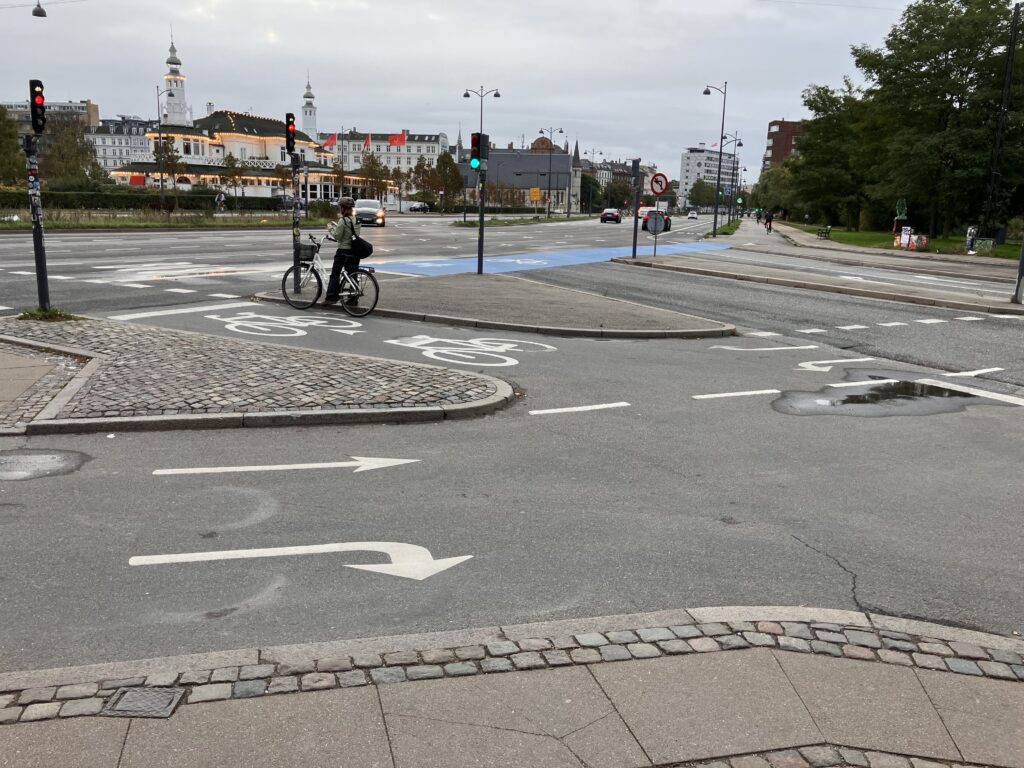
The first time is unsettling. Waiting for the green light, then slowly advancing while extending your left hand upward at 90 degrees to indicate slowing, before swinging right across the crosswalk and coming to a stop facing 90 degrees left. Then dutifully waiting for that light to turn green to proceed. It seemed odd at first so I consulted the web and sat at a corner with my son observing the routine. Four months after leaving Lincoln to resettle in Copenhagen, Denmark, it feels almost second nature.
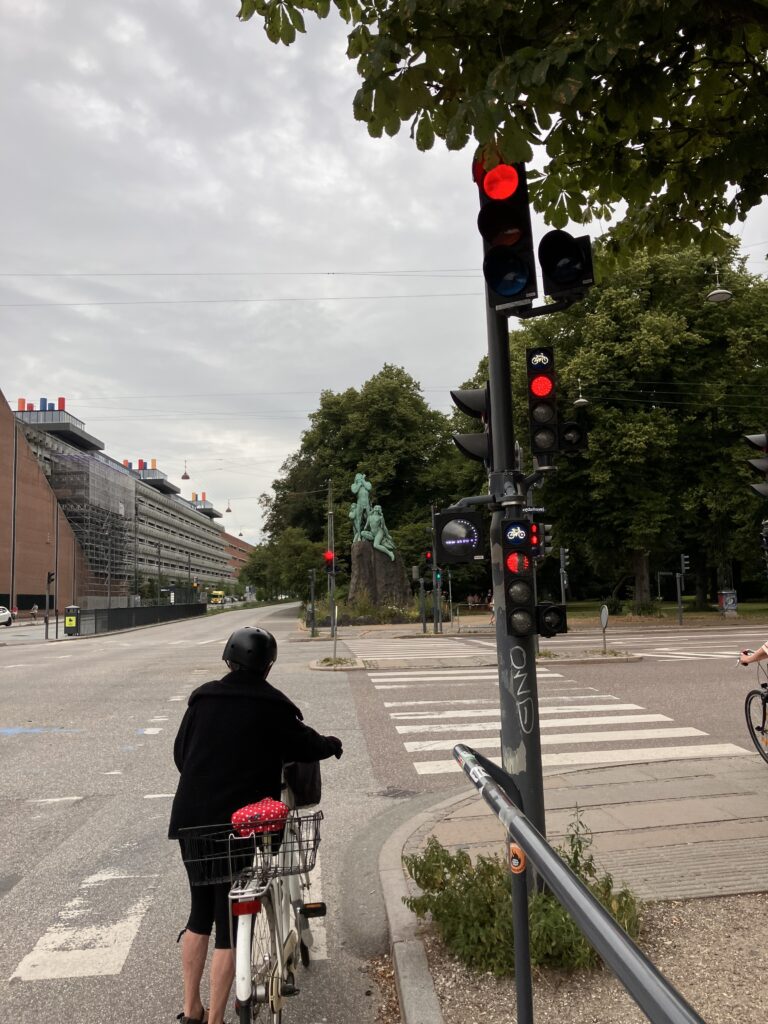
Copenhagen is proud of their biking culture, but they, like the Dutch, cycle because the bicycle is often the fastest way to get where you are going. And there are truly thousands of Danes on their bikes every day, as the bike counters tell me on the busiest bike paths. One day, I just sat in a café sipping coffee and gawking at the morning bike commute. When I have asked Danes about why they bike, they provide many answers that seem to fall into push away from cars and pull towards using bikes.
Certainly, one significant push is the cost of owning, maintaining, insuring, and parking a car. There are many cars here so clearly you can buy them although the taxes alone to purchase a vehicle would make many Lincolnites think twice. Then there is the cost of fuel, currently around $10.50 per gallon. There is no such thing as free parking in Copenhagen, not in your apartments, not at work, not on the street. And lest you think that they would never enforce it, the tickets for not paying to park are often hundreds of dollars, or so I’ve heard from the other new families who thought they could just “run into the school.” Given the exceptional bike and public transport infrastructure, availability of short-term car rentals, and the distances to shops, owning a car in a big city feels unnecessary.
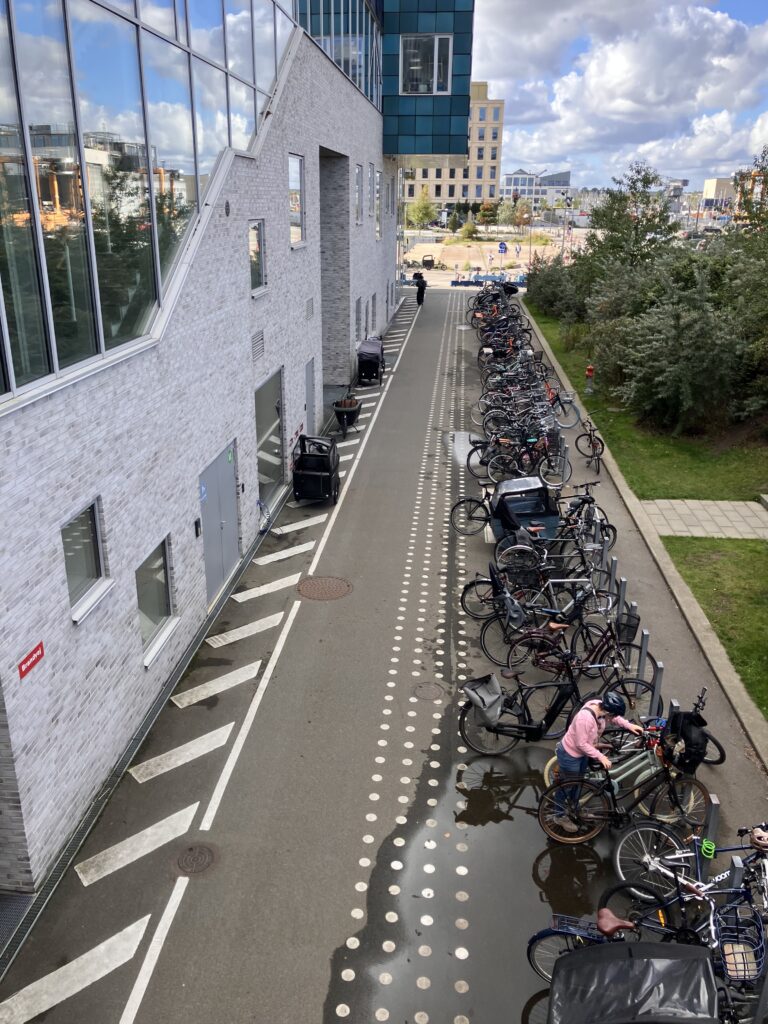
The city has done a lot to pull one towards using a bike in Copenhagen. The city is dense and it appears that each expansion over the last 30-40 years has been accompanied by investments in infrastructure, cycling and transit. That is to say that these expansions are built with the expectation that people will bike or use transit rather than drive. The cycling infrastructure is second to none. Paths from outside of town often are separated or have a bike lane. Arterial streets and many collector streets have a raised bike path with a second curb to the sidewalk. All other streets have bike paths or the expectation that bikes will be present with traffic calming measures. Intersections with traffic signals often have bike-specific signals and even blue painted lanes to tell drivers where to attend to cyclists. While Copenhagen doesn’t have the 30 km/h (~20 mph) speed limit in the city that other major European cities have adopted, there are only a few streets where I’ve observed cars driving over this speed.
Which brings me back to time. The city is designed in such a way that the bike is a solution to getting where you need to be in a timely manner. The subway and regional trains allow bikes so commuters can easily get to their final destination when it is too far to simply cycle there. You can’t even call it a network of bike paths because it is close to saturation such that it is unusual to find places that do not facilitate cycling. Recent data have suggested the number of cyclists has decreased in the last 5 years in Copenhagen, and around Denmark. The reasons are unclear. Like Lincoln, they are wrestling with what it means to have and promote a cycling culture where the humble bicycle is a solution that is better than the car. While the percentage has fallen a few points, alarge portion of the population still sees the bicycle as the fastest way to traverse the city.
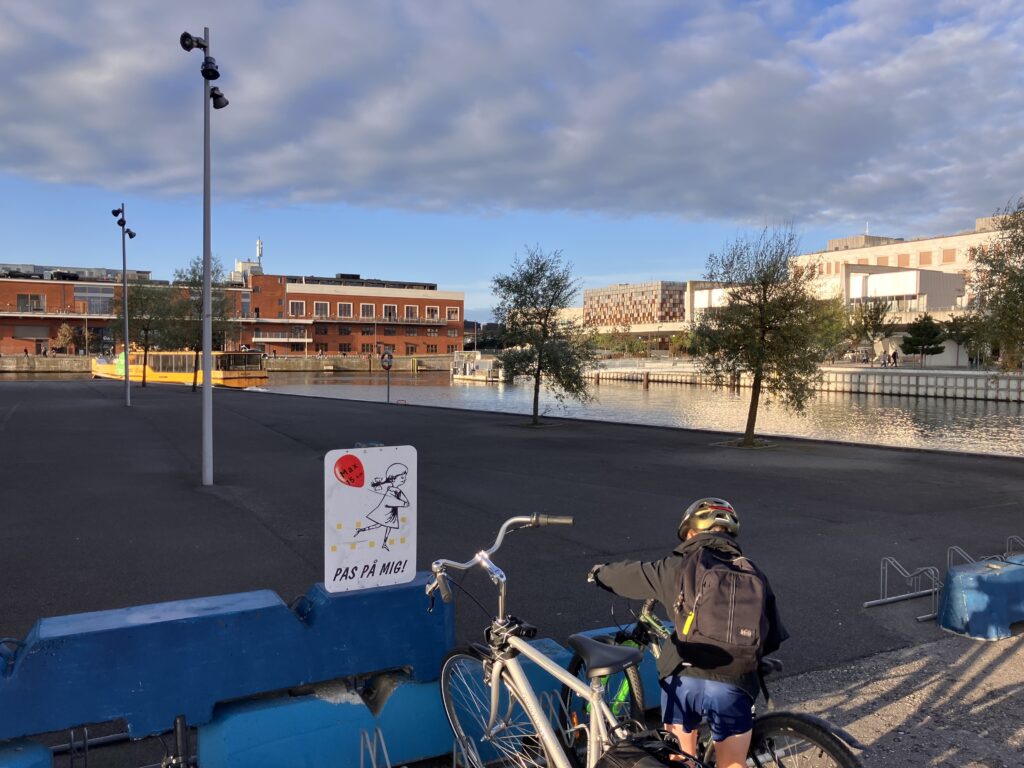
After living in Lincoln for more than a decade and beinginvolved in bike advocacy the last few years, friends have asked what it would take for Lincoln to replicate the Dutch or Danish cycling systems. I propose that a hyperfocus on safety is the cornerstone to cultural change. As a leader of a bike busfor elementary school kids in Lincoln, I heard from many parents that they didn’t feel the roads were safe enough for their kids. Here, cycling becomes the default transport option early on and I regularly see young kids cycling to school alone – telling you a lot about what their parents think of the safety of cycling.
Safety is most noticeable and forefront in your mind at intersections. As I rode through the city recently with person who works with Danish cycling culture, I learned that the engineers have tested many, many different intersection designs to maximize safety of all the users. The planning starts with the pedestrians and bikers and then considers the drivers. One intersection here has been completely redesigned 5 times with the goal of reducing the car-bike/pedestrian interactions, and four of those designs were only partially successful. When problem solving safety, good intentions and solutions in a different context aren’t always the solution to this problem in this intersection. Learning what cycling infrastructure works for Lincoln, and integrating that into how the city changes, will be essential for Lincoln to move from a city with great bike trails, to a cycling city.
If you find yourself visiting Copenhagen and want a bike guide to show you the interesting, and mundane, bike infrastructure, look me up. Then practice two maneuvers that differ between Lincoln and Copenhagen – dodging the tourists who walk in bike paths, and the Copenhagen left.